

“The question is whether you’ll lead this transformation or become another cautionary tale.”
About the Author

Abi Adesanya
Abi Adesanya, Wrangu’s Senior ServiceNow Security Specialist, is a Certified Master Architect with over 15 years’ experience driving successful SecOps implementations on the ServiceNow platform.
Executive Summary
After a decade in cybersecurity and over 15 years specialising in ServiceNow SecOps implementations, I have watched the same painful cycle repeat across dozens of organisations: talented security teams drowning in alerts while real threats slip through undetected. Despite massive investments in cybersecurity tools, we are losing ground to attackers who understand something we have forgotten: “speed and coordination” matter more than tool count.
The pattern is depressingly consistent. Security analysts face an impossible mountain of alerts from dozens of different tools every morning. They spend their days switching between systems, manually copying information, and chasing false positives while sophisticated attacks unfold unnoticed. The result? Burnout, turnover, and security postures that weaken over time despite increased spending.
I have seen this transform completely with properly implemented ServiceNow SecOps Applications. Companies achieve dramatic reductions in incident response time, massive decreases in false positives, and most importantly, security teams that can focus on strategic threats instead of administrative overhead. However, success isn’t guaranteed; it requires understanding why traditional approaches fail and how ServiceNow SecOps provides the path forward.
This series will walk you through that journey, beginning with an assessment of where most security operations typically stand today, drawn from my own experience of seeing the good, the bad, and the “let’s not talk about that again”.
The Security Operations Crisis
In my experience implementing SecOps across industries, the numbers are staggering but unsurprising. The average enterprise SOC I walk into processes over ten thousand alerts daily across their security stack. Even with skilled analysts working around the clock, basic mathematics shows they can only thoroughly investigate a fraction of these alerts. The rest get cursory glances or ignored entirely.
I have watched talented analysts burn out from this relentless pressure. They are drowning in routine triage while complex investigations get rushed. When “close the ticket” beats “understand the problem,” you overlook the details that matter.
Turnover in a SCO is a reality, and ambitious analysts often start exploring their next steps after a couple of years; whether that’s an internal promotion or a move elsewhere. When they progress, some hard-won context goes with them. The remedy isn’t to lament departures but to manage them: capture knowledge in clear runbooks, pair newcomers with experienced mentors, and run a structured ramp-up that gets new analysts productive within a few months. Done well, this keeps alert volumes manageable, protects senior engineers from hidden overload, and turns natural career progression into a healthy talent pipeline rather than a disruption.
Average daily alerts across security stacks
Routine triage takes priority over complex investigations
Widespread pressure on analysts and teams
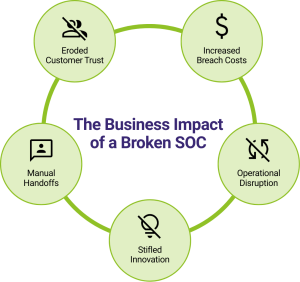
The Cost of Inaction: The Business Impact of a Broken SOC
The consequences of a dysfunctional Security Operations Center extend far beyond the security team.
The business impact is severe and multifaceted.
- Increased Breach Costs: Organizations with inefficient, manual security processes suffer far greater financial damage when a breach occurs. The delays in detection and response give attackers more time to exfiltrate data, disrupt operations, and cause widespread damage, leading to higher recovery costs, regulatory fines, and reputational harm.
- Operational Disruption: A slow or ineffective response to a security incident can bring critical business operations to a halt. I have seen ransomware attacks cripple major retail chains, and data breaches freeze customer-facing services. The result: millions in lost revenue and productivity.
- Eroded Customer Trust: In today’s market, security is a core part of the customer promise. A public breach, especially one that could have been prevented with better operational practices, can irreparably damage customer trust and lead to significant churn.
- Siloed “automation” = manual handoffs: When orchestration stops at team boundaries (e.g., the SOC has to email or ping the EDR team in a chat to quarantine a device), “automation” turns into a relay race. The result is slower containment, inconsistent outcomes, and a fuzzier audit trail.
- Stifled Innovation: When the security team is constantly in a reactive, fire-fighting mode, they become a roadblock to innovation. New business initiatives, cloud adoption projects, and digital transformation efforts are slowed down by a security team that lacks the capacity to be a strategic partner.
Ultimately, the cost of inaction is not just a security budget line item; it’s a direct threat to the organisation’s financial health, operational stability, and competitive position.
Why Traditional Security Operations Fall Short
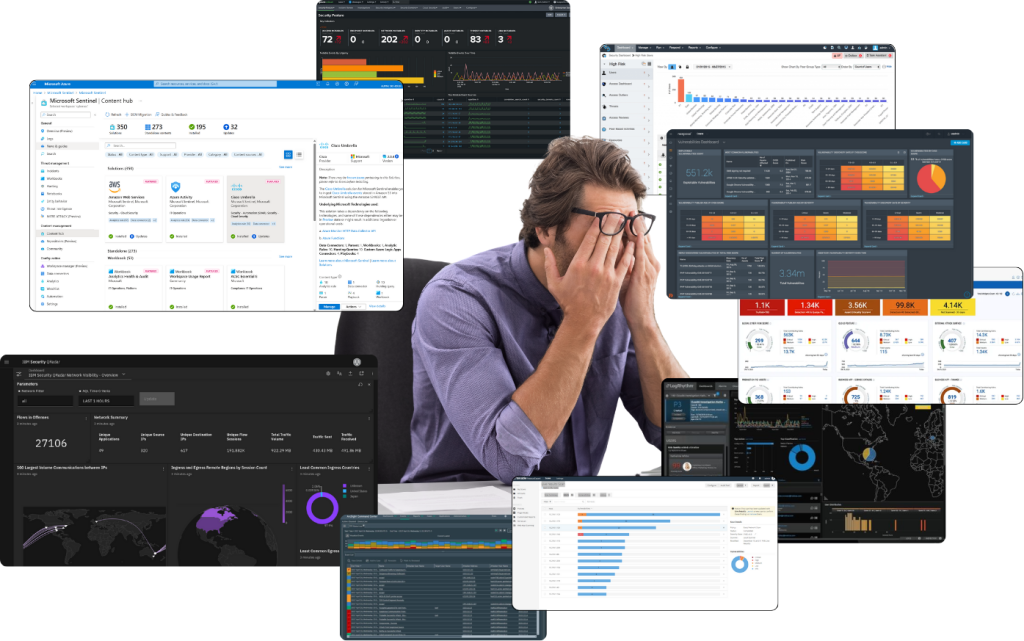
Walk into any modern SOC and you will see what I like to call the “monitor wall of shame”; analysts with multiple screens displaying different security tools. SIEM platforms, EDR consoles, vulnerability scanners, threat intelligence feeds, email security gateways – all generating alerts in isolation.
I have seen the consequences firsthand across dozens of implementations: a phishing email detected by the
email gateway, subsequent malware installation flagged by EDR, and lateral movement identified by network monitoring; all appearing as separate, unrelated events instead of components of a coordinated attack campaign.
This fragmentation creates critical operational problems that I encounter in every traditional SOC:
- Context Loss: Alerts arrive stripped of business context. An EDR alert stating “suspicious process execution” tells analysts nothing about the affected system’s criticality (found in a Configuration Management Database), normal user behaviour patterns (found by analysing the SIEM logs), or potential business impact (determined by the alert threat and assets involved). I have watched analysts spend twenty minutes gathering basic information from all these sources that should be available immediately.
- Alert Multiplication: The same security event often triggers alerts across multiple tools. A single malware infection might generate fifteen different alerts from various security layers, creating false impressions of increased threat volume while overwhelming analysts with redundant investigations.
- Manual Correlation: Analysts become human APIs, manually gathering context from multiple systems to understand the threat scope. What should be a five-minute assessment becomes a forty-five minute investigation across disconnected tools.
Traditional security operations rely heavily on “tribal knowledge” – informal processes that live in analysts’ heads
rather than repeatable workflows and are not captured in documentation or response processes that could be updated
based on their experience. Incident response procedures exist as lengthy, obsolete documents that teams must interpret
under pressure, leading to inconsistent responses and missed steps.
The ServiceNow SecOps Solution: From Chaos to Clarity
ServiceNow Security Operations transforms the tool sprawl nightmare into coordinated intelligence. Rather than replacing existing security investments, SecOps orchestrates them into unified workflows that provide comprehensive threat visibility and coordinated response capabilities.
Across dozens of implementations, the results are consistently impressive. Organisations achieve multiple-fold improvements in incident processing speed, dramatic reductions in mean time to resolve, and significant increases in security team efficiency. The platform includes several integrated applications that work together seamlessly, the most often referenced; Security Incident Response (SIR), Vulnerability Response (VR), Threat Intelligence, and Configuration Compliance.
Unlike traditional tools that prioritise alerts based purely on technical criteria, ServiceNow SecOps integrates with your Configuration Management Database (CMDB) to understand business context. This enables intelligent prioritisation that I have seen transform security operations.
The organisations I have worked with report transformational improvements in measurable security outcomes.
A financial institution I helped managed to reduce their Mean Time To Detect (MTTD) threats by nearly half, and cut their Mean Time To Respond (MTTR) from hours to minutes through automated enrichment and response workflows. Another organisation reduced vulnerability remediation time from months to weeks through Automated Prioritisation and Patch Management workflows integrated with their existing Change Management processes.
Addresses tool overload. by orchestrating existing security tools into coordinated intelligence.
To understand business context necessary for intelligent prioritisation.
Organisations adopting ServiceNow SecOps report transformational improvements in metrics like MTTD and MTTR.
The Urgency of Now
The cybersecurity threat landscape continues evolving at machine speed while traditional security operations remain constrained by human-scale manual processes. Attack sophistication increases daily while security teams struggle with the same operational challenges I encountered five years ago.
ServiceNow SecOps does not just improve existing processes, it fundamentally reimagines security operations around business outcomes, automated intelligence, and coordinated response. Organisations that embrace this transformation position themselves not just to defend against current threats, but to adapt proactively as the landscape evolves.
The wake-up call is clear from my experience across industries: traditional security operations are failing at precisely the moment when effective security has never been more critical. The question is not whether your organisation needs more advanced security operations; the evidence from implementations clearly demonstrates that traditional approaches can’t scale to meet modern threats.
The question is whether you’ll lead this transformation or become another cautionary tale.
Coming Next: Understanding the Ecosystem
In Part 2, “The Foundation Blueprint: Understanding the ServiceNow SecOps Ecosystem,” I will walk through the suite of applications that make up the SecOps platform. We will explore how they work together to create a unified defense system and lay the groundwork for building a successful implementation strategy.
With thanks to Ayner Perez for thoughtful review comments that sharpened this installment, especially the “The SOC Crisis” section.
About Wrangu
Wrangu specialises in ServiceNow security operations transformation, helping organisations evolve from reactive security management to proactive, intelligence-driven defense. Our proven methodologies and deep platform expertise ensure successful SecOps implementations that deliver measurable business outcomes.

